About Cloud Atlas
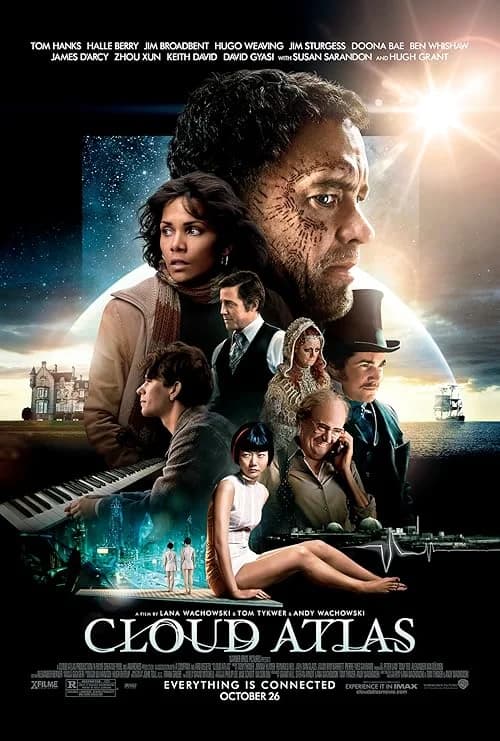
Cloud Atlas (2012) is a breathtaking cinematic achievement that weaves together six distinct narratives spanning from the 19th century Pacific Islands to a post-apocalyptic future. Directed by Lana and Lilly Wachowski alongside Tom Tykwer, this ambitious adaptation of David Mitchell's novel explores how individual actions ripple across time, connecting souls through centuries. The film's revolutionary structure features an ensemble cast including Tom Hanks, Halle Berry, and Hugh Grant playing multiple roles across different timelines, demonstrating remarkable versatility as they embody characters across genders, races, and eras.
The film's central theme of interconnectedness manifests through recurring motifs, musical compositions, and birthmarks that transcend time. From a 19th-century notary's voyage to a futuristic rebellion in Neo Seoul, each story explores themes of freedom, love, and the eternal struggle against oppression. The directors masterfully balance these complex narratives, creating emotional resonance as characters' choices echo through generations.
Cloud Atlas deserves viewing for its sheer ambition and visual poetry. The seamless editing creates hypnotic transitions between eras, while the haunting score reinforces the film's spiritual dimensions. Despite its nearly three-hour runtime, the film maintains compelling momentum through its emotional through-lines. This is cinema as philosophical exploration—a meditation on how kindness and cruelty reverberate through human history. For viewers seeking intellectually stimulating science fiction with profound emotional depth, Cloud Atlas offers an unforgettable experience that rewards multiple viewings.
The film's central theme of interconnectedness manifests through recurring motifs, musical compositions, and birthmarks that transcend time. From a 19th-century notary's voyage to a futuristic rebellion in Neo Seoul, each story explores themes of freedom, love, and the eternal struggle against oppression. The directors masterfully balance these complex narratives, creating emotional resonance as characters' choices echo through generations.
Cloud Atlas deserves viewing for its sheer ambition and visual poetry. The seamless editing creates hypnotic transitions between eras, while the haunting score reinforces the film's spiritual dimensions. Despite its nearly three-hour runtime, the film maintains compelling momentum through its emotional through-lines. This is cinema as philosophical exploration—a meditation on how kindness and cruelty reverberate through human history. For viewers seeking intellectually stimulating science fiction with profound emotional depth, Cloud Atlas offers an unforgettable experience that rewards multiple viewings.